
When we hear the word Artificial Intelligence, many people imagine robots, big machines, or some advanced future technology. But in reality, AI is already part of our daily life.
I first noticed it in a very simple way while using my Samsung phone camera. Sometimes, when I captured a photo, the image looked different after clicking. The colors became better, brightness improved, shadows looked balanced, and the final photo appeared more polished than the original scene.
At that time, it felt like the phone was doing something smart in the background. And that is one of the easiest ways to understand Artificial Intelligence.
AI is not always complicated. Many times, it quietly works inside our phones, cameras, apps, search engines, editing tools, and social media platforms.
So, let’s understand Artificial Intelligence in a simple and beginner-friendly way.
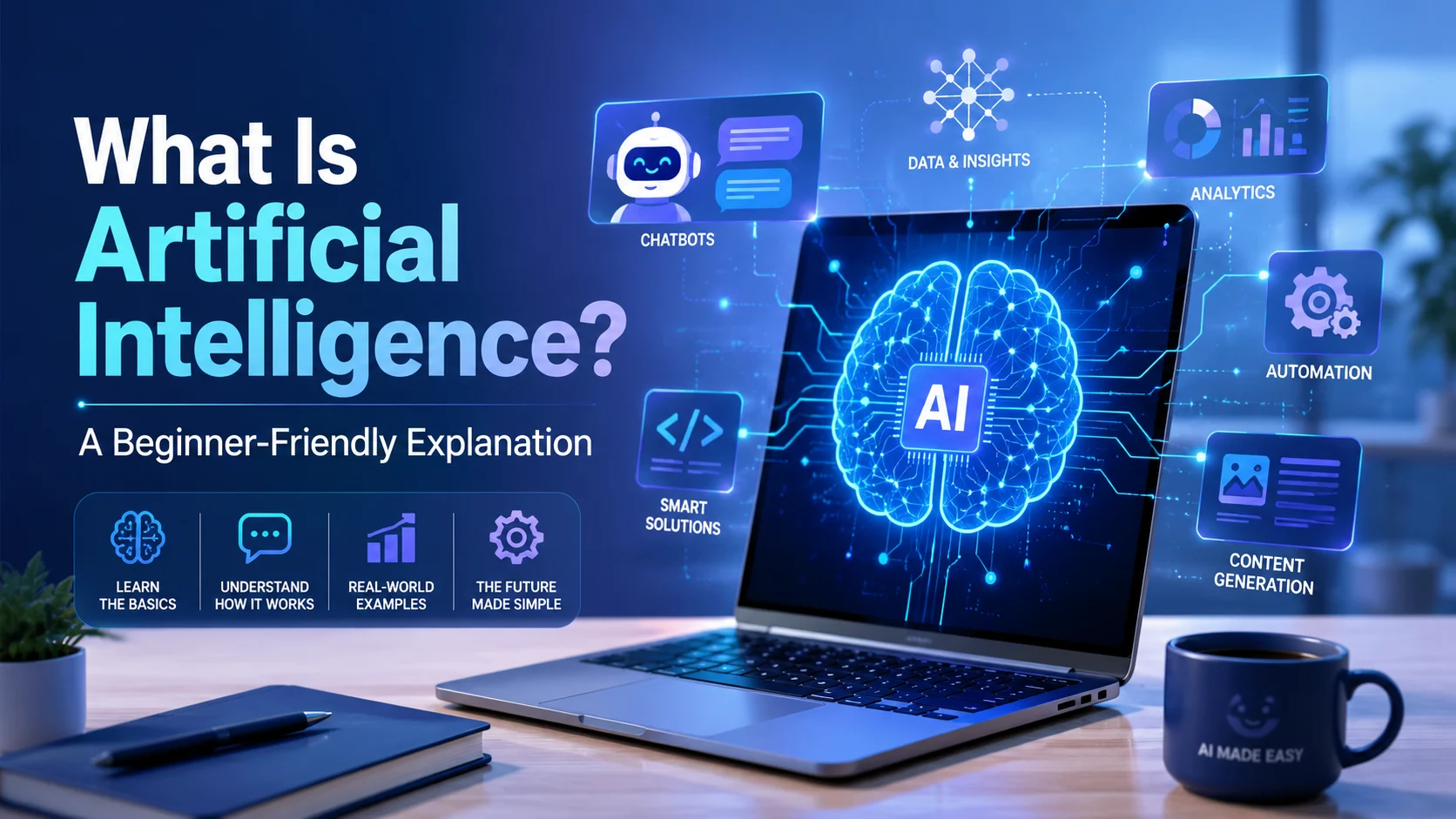
What Is Artificial Intelligence?
Artificial Intelligence, or AI, is a technology that allows machines and software to perform tasks that usually need human intelligence.
These tasks can include:
- Understanding language
- Recognizing images
- Improving photos
- Making decisions
- Learning from data
- Solving problems
- Giving recommendations
- Creating text, images, videos, or music
In simple words, AI helps machines act smartly by learning from information and patterns.
AI does not mean that a machine has human emotions or real human thinking. It means the machine can process data, understand patterns, and give useful results.
Simple Meaning of Artificial Intelligence
Let’s understand AI with a basic example.
When you take a photo from your smartphone, the camera does not only capture the image. It may also improve the photo automatically.
It can adjust:
- Brightness
- Contrast
- Skin tone
- Colors
- Background blur
- Sharpness
- Night mode
- Face detection
This automatic improvement is possible because of smart software and AI-based processing.
So, Artificial Intelligence means:
A machine or software that can learn, understand, and improve results without needing step-by-step human instructions every time.
How Does Artificial Intelligence Work?
AI may sound complex, but the basic idea is simple. It works through data, patterns, and algorithms.
1. AI Uses Data
AI needs data to learn.
This data can be:
- Photos
- Videos
- Text
- Voice
- Numbers
- User behavior
- Search history
For example, a phone camera AI may learn from millions of photos to understand faces, lighting, colors, objects, and backgrounds.
2. AI Finds Patterns
After studying data, AI starts finding patterns.
For example, if AI sees many photos of human faces, it learns how eyes, nose, lips, skin tone, and face shapes usually look. This helps the camera detect faces and improve portraits.
3. AI Gives Smart Results
Once AI understands patterns, it can give better results.
For example:
- Your camera improves photos
- YouTube recommends videos
- Google Maps suggests faster routes
- Gmail detects spam emails
- ChatGPT writes answers
- Editing apps remove background noise
This is how AI works quietly behind many tools we use every day.
Daily Life Examples of Artificial Intelligence
You may already be using AI every day without realizing it.
AI in Smartphone Cameras
Modern smartphone cameras use AI to improve photos and videos. For example, when you click a photo from a Samsung phone, the camera may automatically enhance the image after capturing it. It can make the sky look better, improve low-light shots, sharpen details, and balance colors.
This is a very common example of AI in daily life.
AI in Social Media
Apps like Instagram, YouTube, Facebook, and TikTok use AI to understand what you like.
They recommend:
- Reels
- Videos
- Posts
- Ads
- Pages
- Trending content
When you watch more videos about editing, gadgets, or AI tools, the platform starts showing you similar content. This happens because AI studies your activity and predicts your interests.
AI in Search Engines
Search engines use AI to understand what you are searching for. Even if you type a wrong spelling, Google often understands your meaning and shows the correct results. It can also suggest related questions, images, videos, and websites.
AI in Voice Assistants
Voice assistants like Google Assistant, Siri, and Alexa use AI to understand your voice commands.
You can ask them to:
- Set alarms
- Play music
- Search something
- Call someone
- Open apps
- Give weather updates
They understand your language and respond with useful information.
AI in Video Editing Tools
Many editing tools now use AI features.
For example, AI can help with:
- Auto subtitles
- Background removal
- Noise reduction
- Audio enhancement
- Auto reframing
- Scene detection
- Color correction
- Script generation
For creators and video editors, AI can save a lot of time.
Types of Artificial Intelligence
There are many technical types of AI, but beginners can understand it through these simple categories.
1. Narrow AI
Narrow AI is designed to do one specific task.
Examples include:
- Face unlock
- Spam filters
- YouTube recommendations
- Google Maps navigation
- Smartphone camera enhancement
- Chatbots
Most AI tools we use today are Narrow AI.
2. General AI
General AI means a machine that can think and learn like a human across many different tasks.
This type of AI does not fully exist yet. It is still a future goal in the world of research and technology.
3. Generative AI
Generative AI can create new content.
It can create:
- Text
- Images
- Videos
- Music
- Voice
- Code
- Designs
Tools like ChatGPT, Gemini, Midjourney, Canva AI, and Runway are examples of Generative AI tools. This type of AI is especially useful for students, creators, marketers, designers, and business owners.
Artificial Intelligence vs Machine Learning
Many beginners get confused between Artificial Intelligence and Machine Learning.
Here is the simple difference:
Artificial Intelligence is the bigger concept. Machine Learning is a method that helps machines learn from data.
For example, AI is the main idea. Machine Learning is one way to make AI work. Instead of programming every single rule, Machine Learning allows computers to learn from examples.
Example: If we show a system thousands of dog photos, it can slowly learn what a dog looks like. Later, it can identify a dog in a new photo. That is Machine Learning.
Artificial Intelligence vs Human Intelligence
AI is powerful, but it is not the same as human intelligence.
Humans have:
- Emotions
- Imagination
- Real-life experience
- Moral judgment
- Personal values
- Creativity
- Common sense
AI works mainly through data and patterns. It can generate smart results, but it does not truly feel emotions or understand life like humans do.
That is why human creativity is still very important.
AI can help you write a script, but your experience makes it meaningful.
AI can improve a photo, but your eye decides the best frame.
AI can suggest ideas, but your thinking gives them direction.
Benefits of Artificial Intelligence
Artificial Intelligence has many benefits when used properly.
1. AI Saves Time
AI can complete repetitive tasks quickly.For example, instead of manually writing subtitles for a video, AI can generate them in minutes.
2. AI Improves Productivity
Students, creators, freelancers, teachers, and business owners can complete more work in less time.AI can help with writing, editing, planning, designing, research, and automation.
3. AI Helps Beginners Learn Faster
AI can explain difficult topics in simple words.For example, a beginner can ask:This makes learning easier and faster.
4. AI Supports Creativity
AI can help creators with:
- Video ideas
- Blog outlines
- Social media captions
- Thumbnail concepts
- Script writing
- Image generation
- Editing suggestions
It does not replace creativity. It supports it.
5. AI Improves Decision-Making
Businesses can use AI to analyze data and make better decisions. For example, AI can help understand customer behavior, product demand, ad performance, and sales trends.
Also Read: The Future Is Now: How Ai Tools Are Shaping Future
Limitations of Artificial Intelligence
AI is useful, but it is not perfect.
Some limitations include:
- AI can give wrong answers
- AI can misunderstand context
- AI depends on data quality
- AI may copy bias from data
- AI needs human checking
- AI can be misused
- AI does not have real emotions
So, we should not blindly trust AI. We should use it as a smart assistant and always apply human judgment.
Will AI Replace Humans?
This is one of the biggest questions today.
The simple answer is:
AI may replace some repetitive tasks, but it will also create new opportunities.
For example, a video editor who learns AI tools can work faster. A writer who understands AI can create better drafts. A small business owner can use AI for marketing, posters, captions, and customer replies.
AI may not replace every person, but people who use AI smartly will have an advantage.The future belongs to people who combine human creativity with AI skills.
Why Beginners Should Learn Artificial Intelligence
AI is becoming a basic digital skill.Just like computer knowledge became important in the past, AI knowledge is becoming important today.
Beginners should learn AI because it can help in:
- Education
- Freelancing
- Content creation
- Video editing
- Digital marketing
- Business growth
- Career development
- Personal productivity
You do not need to become a programmer to start using AI. Many AI tools are simple and beginner-friendly.
Practical Ways to Start Using AI
Here are some easy ways to start using AI.
1. Use AI for Learning
Ask AI to explain difficult topics in simple language.
Example prompt:
Explain machine learning in simple words with examples.
2. Use AI for Writing
You can use AI to write:
- Emails
- Blog posts
- Captions
- Product descriptions
- Resumes
- Scripts
- Ad copy
Always edit the result in your own style.
3. Use AI for Video Creation
Creators can use AI for:
- Script ideas
- Voiceover drafts
- Subtitle generation
- Background removal
- Audio cleaning
- Thumbnail ideas
This can make the content creation process faster.
4. Use AI for Photo Editing
Many apps use AI to improve images automatically.
For example, your smartphone camera may enhance the photo after clicking. Editing apps can also remove objects, improve lighting, sharpen faces, and change backgrounds.
5. Use AI for Business
Small businesses can use AI for:
- Social media captions
- Festival offers
- Customer replies
- Poster ideas
- Product descriptions
- Marketing plans
- WhatsApp messages
This makes AI useful even for local shops and service-based businesses.
The Future of Artificial Intelligence
The future of AI looks very powerful.
AI will become more common in:
- Education
- Healthcare
- Agriculture
- Video production
- Digital marketing
- Customer support
- Smart devices
- Transportation
- Robotics
- Business automation
But the most important thing is this:
AI is a tool. Human thinking gives it direction.
AI can give speed, but humans give purpose.
AI can generate ideas, but humans add emotion.
AI can process data, but humans make meaningful decisions.
FAQs About Artificial Intelligence
1. What is Artificial Intelligence in simple words?
Artificial Intelligence is a technology that helps machines perform tasks that usually need human intelligence, such as learning, understanding language, recognizing images, and making decisions.
2. What is an example of Artificial Intelligence?
A simple example is your smartphone camera. When it improves a photo after clicking by adjusting colors, brightness, and sharpness, AI may be working in the background.
3. Is AI difficult to learn?
No, AI is not difficult to learn if you start with simple tools and practical examples. Many AI tools today do not require coding knowledge.
4. Is ChatGPT an AI tool?
Yes, ChatGPT is an AI tool. It can understand text prompts and generate answers, ideas, explanations, scripts, and more.
5. Can AI replace humans?
AI can replace some repetitive tasks, but it cannot fully replace human creativity, emotions, real-life experience, and judgment.
6. How can beginners use AI?
Beginners can use AI for learning, writing, content ideas, photo editing, video editing, business planning, and daily productivity.
Conclusion
Artificial Intelligence is no longer just a future technology. It is already part of our daily life. From smartphone cameras and social media recommendations to search engines, video editing tools, chatbots, and business automation, AI is quietly working everywhere. The easiest way to understand AI is this:
Artificial Intelligence helps machines learn from data and perform smart tasks.
For beginners, AI may sound technical at first, but it becomes simple when we connect it with real-life examples. Even something as common as a Samsung phone improving a photo after clicking can help us understand how AI works in the background.
AI is not here only for big companies or experts. Students, creators, freelancers, teachers, small business owners, and everyday users can all benefit from it.
The best approach is to learn AI step by step and use it wisely.