
For years, smartphone users have been handed one AI assistant and told to make do. Apple gave us Siri. Google gave Android users Assistant. The message was always the same: here is your AI, take it or leave it. That era is now over — and the announcement that came out of Apple Park this week signals something genuinely exciting for anyone who cares about the future of technology.
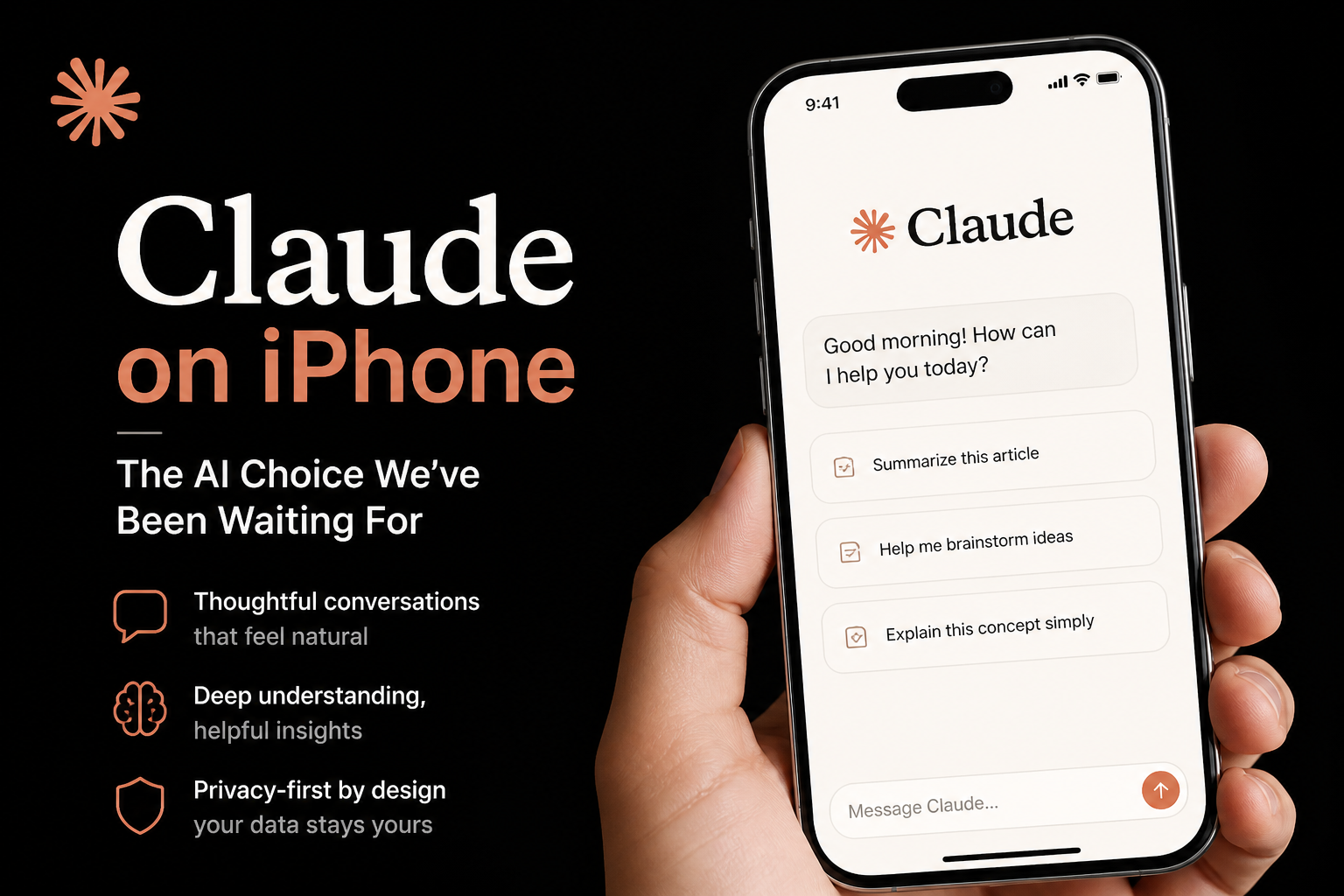
At what turned out to be Tim Cook’s final WWDC keynote as Apple CEO, the world watched Apple unveil not just a smarter Siri — powered by Google’s Gemini — but a multi-AI Extensions system that, for the first time ever, opens the iPhone to third-party AI assistants. Chief among them: Anthropic’s Claude. Starting with iOS 27, iPhone users will be able to choose Claude as their AI of choice directly from their device settings.
This is a big deal. Not just for Anthropic. Not just for Apple. But most importantly, for you — the user.
Choice Is Always Good for Users
Let’s be direct about this: more AI choice on your phone is unambiguously good for consumers. For too long, the AI experience on smartphones has been a monopoly wrapped in sleek hardware. You got what the platform decided you’d get, and you were expected to be grateful.
The reality, though, is that different AI assistants are genuinely better at different things. Claude, built by Anthropic with a heavy focus on safety, nuance, and long-form reasoning, excels at tasks that require careful thinking — writing, analysis, research, complex problem-solving. Having the ability to select the right AI for the right job, directly from your iPhone, is the kind of user empowerment that the tech industry rarely delivers without being pushed.
This is the smartphone AI equivalent of being able to choose your default browser. It seems obvious in hindsight, but it took years and regulatory pressure to get there. Apple opening its AI layer to multiple providers is a watershed moment.
What This Means for How We Use Our Phones
Think about what this practically unlocks. A student writing a research paper can tap into Claude’s thoughtful, citation-aware responses. A professional drafting a sensitive email can lean on Claude’s nuanced tone. A developer debugging code can choose whichever model fits their workflow best. The iPhone becomes a more powerful tool precisely because it stops pretending one AI fits every use case.
The multi-AI Extensions system Apple announced is cleverly designed. Rather than forcing users to jump between apps, it integrates third-party models — including Claude — at the operating system level. This means Claude could power responses inside Messages, Mail, Notes, and other native apps, depending on how Apple rolls out the feature. The AI is woven into the fabric of the device, not bolted on as an afterthought.
The Broader Signal: Competition Is Heating Up
Apple’s announcement doesn’t exist in a vacuum. It arrives at a moment when the AI landscape is more competitive than it has ever been. ChatGPT still holds the largest share of AI users worldwide, but the gap is narrowing. Claude, Gemini, and a growing number of specialized models are each carving out loyal user bases. By building an extensible AI architecture into iOS 27, Apple is essentially acknowledging that no single AI — not even the Gemini-powered Siri — will dominate every use case forever.
This is the right bet. The history of technology tells us that open platforms eventually beat closed ones. By inviting Claude and others in, Apple is future-proofing its ecosystem rather than doubling down on a single AI horse.
Why This Feels Like a Turning Point
There is something symbolic about this happening at Tim Cook’s final keynote. Cook spent over a decade making Apple the world’s most valuable company by mastering the art of the controlled ecosystem. For him to exit the stage with a keynote that fundamentally opens that ecosystem to AI competition says something profound about where the industry is heading.
The future of AI on smartphones is not a single assistant that knows everything. It is a thoughtful, flexible layer that connects users to the right intelligence at the right moment. Apple has just laid the foundation for that future — and Claude’s presence on iPhone is proof that the walls are coming down.
For users, this is the best possible news. More choice, more competition, and ultimately, smarter, more useful devices. The AI wars on your smartphone are just getting started — and as a user, you are the one who wins.
What do you think about Claude coming to iPhone? Will you switch your default AI assistant? Share your thoughts.