
AI is changing very fast, but every update is not useful for normal people. As a creator, I always look at one simple thing: can this technology help in real work? Can it help in video editing, voiceovers, captions, customer support, content creation, or learning?
One of the latest important AI updates is from OpenAI. The company has introduced new real-time voice AI models for developers through its API. These models are made to understand speech, translate conversations, transcribe audio, and respond in real time. This is a big step because voice is the most natural way humans communicate.
What Is OpenAI’s Real-Time Voice AI Update?
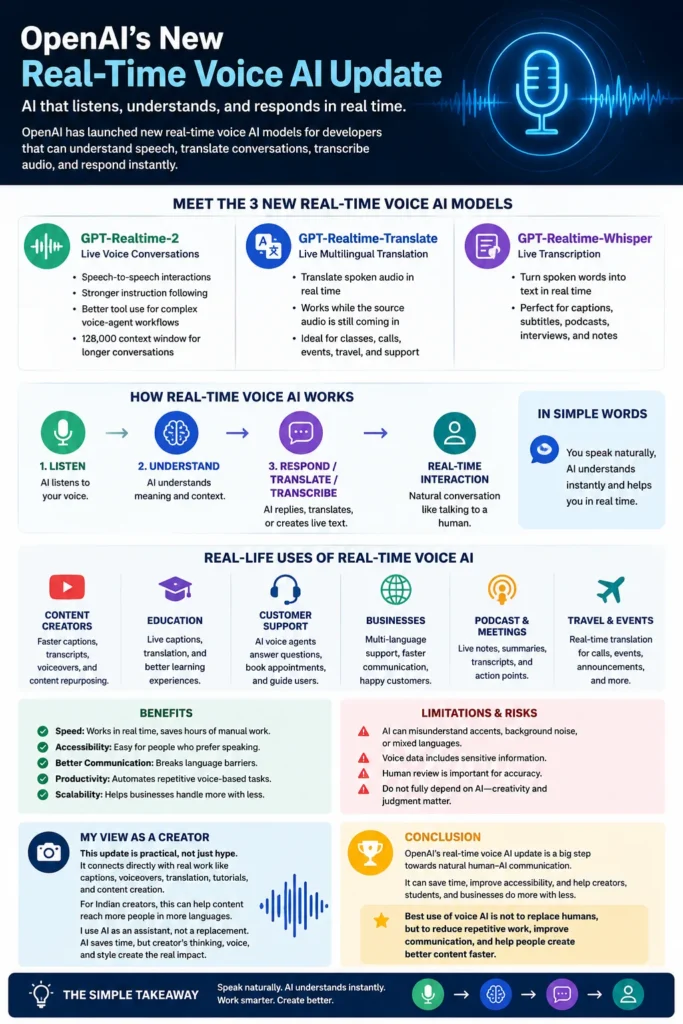
OpenAI’s real-time voice AI update includes three new audio models: GPT-Realtime-2, GPT-Realtime-Translate, and GPT-Realtime-Whisper. These models are designed for developers who want to build voice-based apps, AI assistants, customer support agents, translation tools, and live transcription systems.
In simple words, this update helps apps listen to people while they are speaking and respond quickly. It is not just normal speech-to-text. It is more like a voice AI system that can understand the meaning, follow the conversation, and help complete tasks.
A simple meaning of real-time voice AI is this: it allows people to talk to software naturally, instead of only typing commands.
How Does This AI Voice Technology Work?
The process is easy to understand. First, the AI listens to your voice. Then it understands what you are saying. After that, it can reply, translate, or create a live transcript.
GPT-Realtime-2 is focused on live voice conversations. OpenAI says it supports speech-to-speech interactions, stronger instruction following, and better tool use for complex voice-agent workflows. It also has a 128,000 context window, which helps it handle longer conversations better.
GPT-Realtime-Translate is made for live multilingual translation. It can translate spoken audio while the source audio is still coming in. This can be useful for online classes, international calls, travel apps, events, and customer support.
GPT-Realtime-Whisper is focused on live transcription. This means it can turn spoken words into text while someone is speaking. For creators, this can be useful for captions, subtitles, podcasts, interviews, and video notes.
Why This Update Is Important
This update is important because voice can make technology easier for beginners. Many people are not comfortable typing long prompts or using complicated apps. But they can speak naturally.
In India, this is even more useful because people use many languages and accents. Many users are more comfortable speaking in Hindi, Tamil, Telugu, Bengali, Marathi, or other regional languages than typing in English. If AI voice tools improve, more people can use digital tools without feeling technical pressure.
For businesses, this can improve customer support. A small business can use a voice AI agent to answer common questions, collect customer details, book appointments, or guide users. For education, it can help with live captions and translation. For creators, it can save time in editing and content production.
Real-Life Uses of Real-Time Voice AI
Real-time voice AI can be used in many practical ways. A YouTuber can record a video and generate captions faster. A podcast creator can create transcripts without doing everything manually. A teacher can explain a topic and provide live captions for students.
A local business can use AI voice support for basic customer queries. A travel company can build an assistant that answers questions in different languages. A meeting app can create live notes and summaries from spoken discussion.
As a creator, I see a lot of value here. When I work with content, editing, AI tools, and digital skills, voice is always part of the process. Voiceovers, captions, scripts, tutorials, and client communication all take time. Better voice AI can reduce this workload.
READ: The Future Is Now: How Ai Tools Are Shaping Future
Benefits of OpenAI Real-Time Voice AI
The biggest benefit is speed. Instead of recording audio, uploading it, and waiting for results, real-time voice AI can work while the person is speaking.
Another benefit is accessibility. People who cannot type fast can still use apps through voice. Students can learn better with captions. Creators can repurpose videos into blogs, subtitles, and short-form content more easily.
It can also help businesses become faster. Customer support teams can handle simple questions quickly, while human staff can focus on serious issues.
Limitations and Risks
This technology is powerful, but it is not perfect. AI can still misunderstand words, accents, background noise, or mixed-language speech. That is why human checking is important, especially for important content.
Privacy is another major point. Voice data can include personal details, business information, or sensitive conversations. Companies using AI voice tools must handle user data carefully.
Creators should also avoid fully depending on AI. AI can help with speed, but final quality still needs human creativity, editing, and judgment.
My Personal View as a Creator
From my perspective, this OpenAI voice AI update is very practical. It is not just a fancy AI announcement. It connects directly with real work like captions, voiceovers, translation, tutorials, customer support, and content creation.
For Indian creators, this can be very helpful. Many creators are strong in their own language but hesitate to reach a wider audience. Real-time translation and transcription can help content travel across languages.
But I would use this technology as an assistant, not as a full replacement. AI can speed up the workflow, but the creator’s thinking, voice, and style are still the most important part.
Conclusion
OpenAI’s real-time voice AI update shows where technology is going. The future of AI will not be only about typing prompts. It will also be about speaking naturally with apps, tools, and digital assistants.
The simple meaning is this: AI is becoming better at understanding live human speech.
For creators, students, businesses, and beginners, this can save time and make technology easier to use. But like every AI tool, it should be used carefully. The best use of voice AI is not to replace humans. The best use is to reduce repetitive work, improve communication, and help people create better content faster.